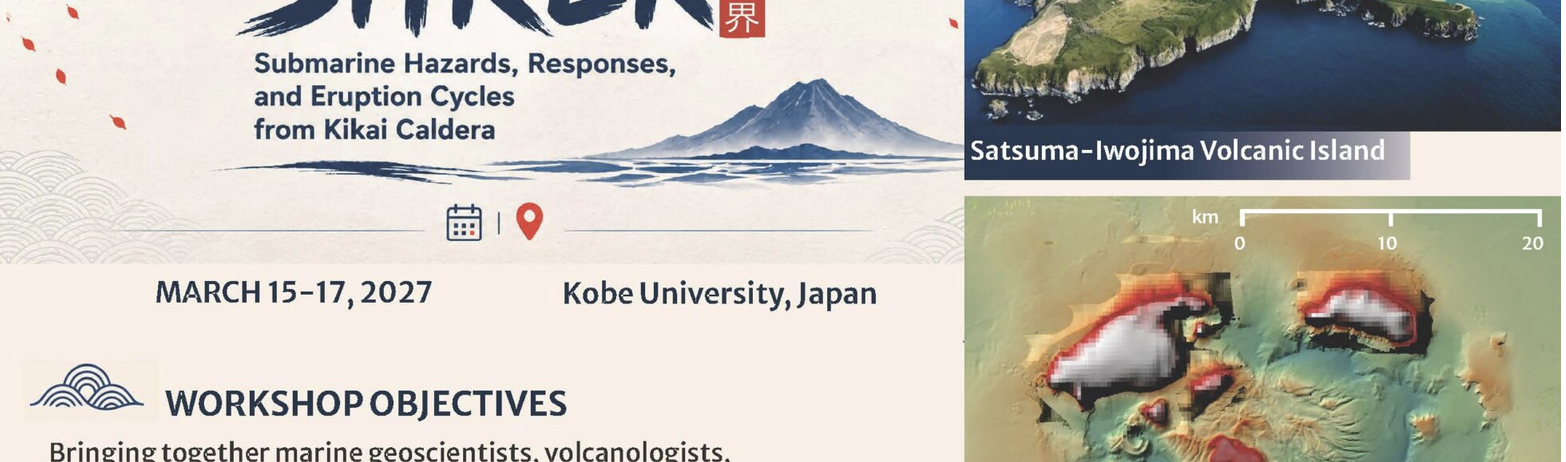
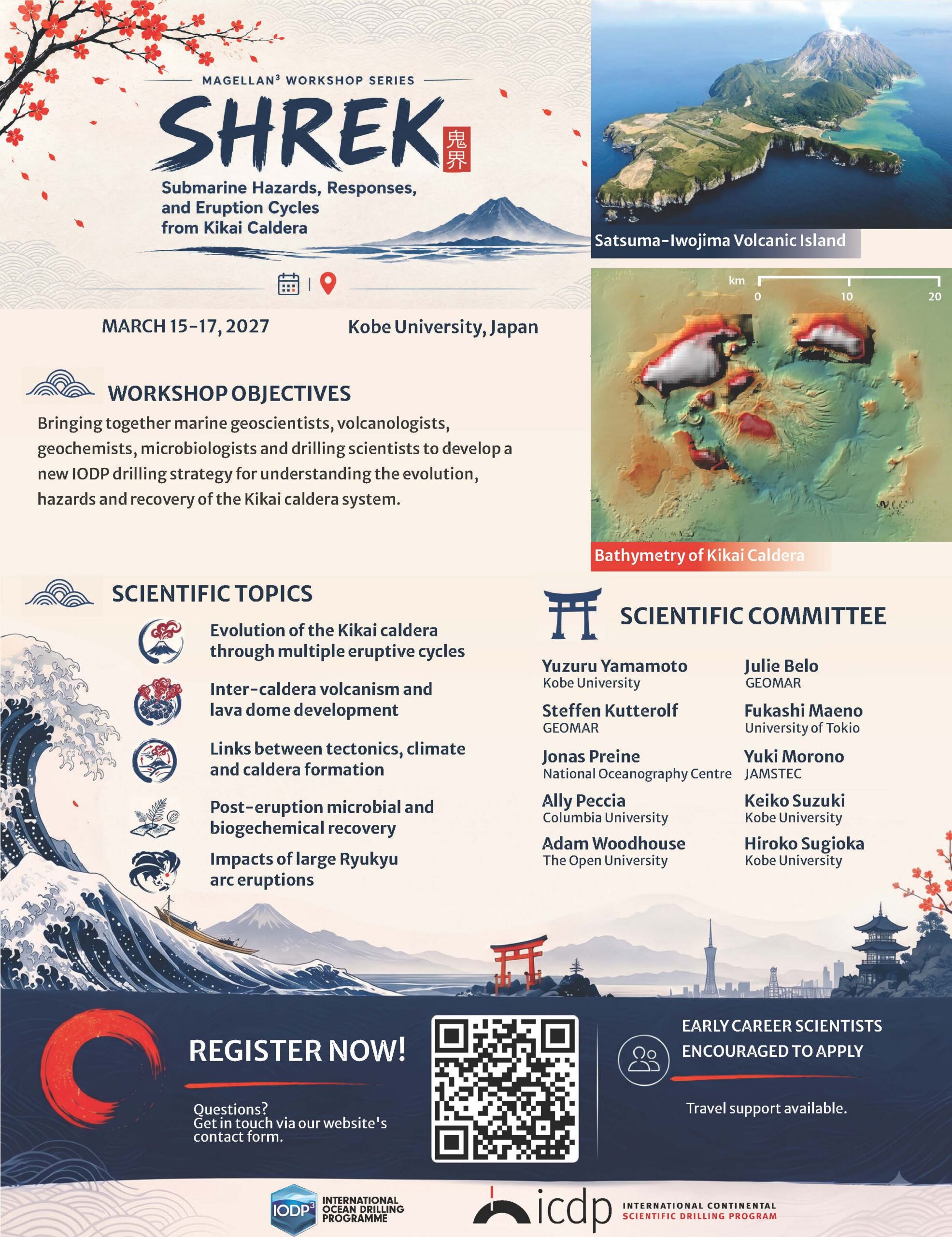
Workshop Magellan³ : Submarine Hazards, Responses, and Eruption Cycles from Kikai Caldera
La communauté est invitée à s’inscrire au Workshop ECORD/Magellan3 intitulé « Submarine Hazards, Responses, and Eruption Cycles from Kikai Caldera » qui se tiendra à l’Université de Kobe (Japon) du 15 au 17 mars 2027. Il est possible de demander un financement pour y participer
| Inscription en ligne (inscription) | Date limite : 31 décembre 2026 (si vous voulez demander une aide financière pour le voyage) |
| Workshop | 15-17 mars 2027 |
Contenu scientifique (en anglais)
Caldera volcanism generates catastrophic geohazards, including tsunamis, seafloor disruption, and widespread ash dispersal, that alter regional landscapes and global climate. Despite extreme socio-economic risks, submarine caldera complexes and their eruption cycles remain poorly understood. The mostly submerged Kikai Caldera (Japan) is the ideal natural laboratory to resolve these blind spots via deep drilling. We hold the SHREK Magellan3 workshop in Kobe, Japan, to advance our active IODP3 pre-proposal (1122-Pre) into a full drilling proposal. The workshop will refine core scientific hypotheses and define optimal drilling targets for the R/V Chikyu.
Preliminary working hypotheses identified and which will be discussed during the proposed Magellan3 workshop in Kobe are:
- The Kikai volcanic system has grown through multiple Quaternary caldera cycles, involving more frequent large eruptions than currently known, affecting the seafloor and mainland Japan.
- The recent lava dome and sediment accumulations within Kikai Caldera record the early inter-caldera stage of the volcanic system and the systematics behind recurrent silicic caldera cycles in coastal volcanic fields.
- Caldera-forming volcanism in the extensional Northern Ryukyu region includes progressively increasing caldera sizes modulated by external forces, such as tectonics and climate.
- Ash alteration and hydrothermal fluids create redox, nutrient, and metal gradients that structure subseafloor microbial communities and control biogeochemical recovery after large eruptions.
- Larger eruptions of Northern Ryukyu arc calderas have modulated and shaped the regional climate and ecology.
Informations pratiques
- Lieu : Le workshop se tiendra à Kobe dans les locaux de l’université. Une description détaillée est disponible sur le site du workshop.
- Quand : Du 15 au 17 mars 2027
- Soutien financier: Les frais d’inscription au workshop sont gratuit pour les inscrits, les frais associés aux voyages étant à votre charge. Un soutien financer partiel est possible: les Chercheurs en Début de Carrière (ECR : Early Career Researchers) seront prioritaires. Veuillez indiquer lors de l’inscription si vous souhaitez demander un soutien financier aux frais de voyage.
- Programme de l’atelier : non communiqué
Pour plus d’informations ou si vous avez des questions, veuillez contacter la page de contact