Appel à « embarquer » – Expédition SPARC 506S: SIGNALS: Stratigraphic InteGration of North Atlantic Legacy Sites 🗓️2026-02-11
Une campagne « à terre » pour revisiter les échantillons et données collectés dans l’Atlantique Nord lors des précédentes campagnes de forage océaniques. Ce projet SPARC durera trois ans, avec un échantillonnage à Brème fin 2026 ou début 2027.
| Wébinaire explicatif | 18 décembre 2025 (enregistrement) |
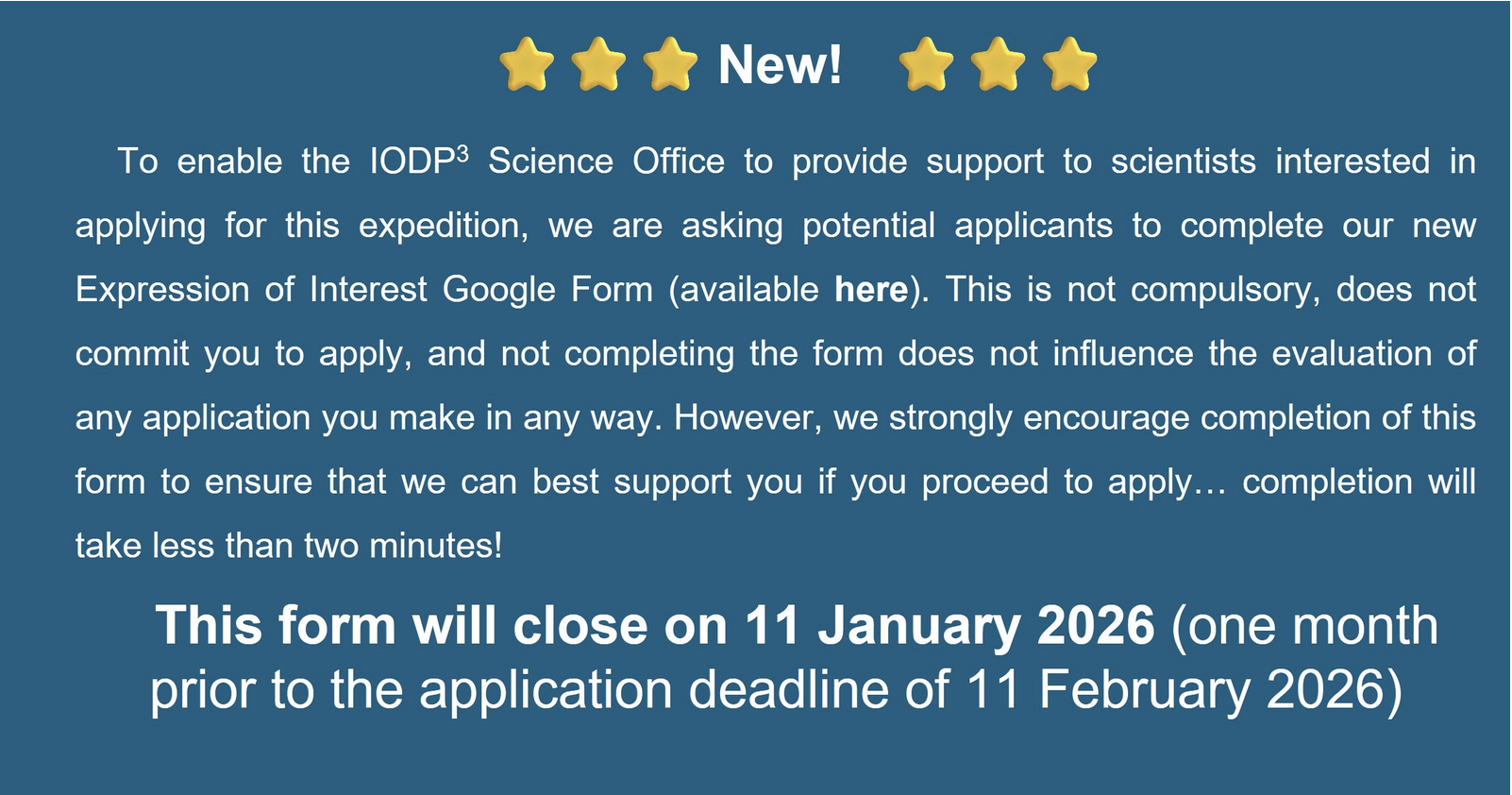
| Date limite de l’expression d’intérêt | 11 janvier 2026 |
| Date limite de candidature | 11 février 2026, 23h59 (heure GMT) |
L’expédition IODP³ 506S est une expédition SPARC (Scientific Projects using ocean drilling ARChives – campagne sans nouveau forage, utilisant des archives de forage océanique). La campagne se base sur l’échantillonnage et l’analyse d’anciennes carottes collectées lors de missions IODP, ODP et DSDP en Atlantique Nord. Elle se tiendra dans la carothèque de Brême (Bremen Core Repository), en Allemagne. Nous invitons les scientifiques ayant un intérêt et une expertise pertinents vis-à-vis des objectifs de l’expédition à postuler pour devenir membre de l’équipe scientifique de l’expédition IODP³. Cet appel est ouvert aux candidats basés dans les nations participant actuellement au programme IODP³. Toute personne en activité dans un laboratoire français peut donc poser sa candidature.
Contexte scientifique (en anglais)
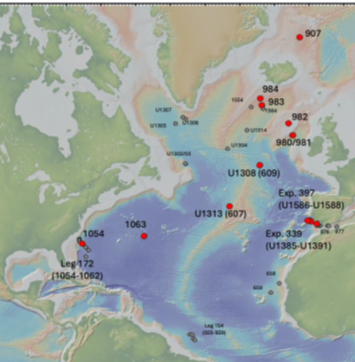
The North Atlantic is one of the most climatically variable and sensitive regions in the oceans as it is prone to mode jumps in the Atlantic Meridional Ocean Circulation (AMOC). While many ODP/IODP expeditions have recovered continuous, high-resolution sediment sequences in the North Atlantic, a comprehensive integration of these legacy sites remains incomplete. These cores contain distinct signals of orbital- and suborbital-scale climate variability but many have not been fully exploited because they have not been properly correlated and integrated across the entire North Atlantic. The SIGNALS (Stratigraphic InteGration of North Atlantic Legacy Sites) expedition aims to synthesize and integrate these legacy records into a coherent, four dimensional stratigraphic framework to provide a regional reconstruction of past climate variability on millennial to orbital timescales since the late Miocene.
Stratigraphic correlation and chronology are at the heart of the SIGNALS project because it is a prerequisite for interpreting past climate history and identifying the forcings and dynamics of climate change. IODP³ Expedition 506S will synchronize records across multiple North Atlantic sites to answer key paleoclimate questions regarding orbital- and millennial-scale climate variability from the late Miocene to present. Climate variability will be placed in an orbitally-tuned chronologic framework with robust estimates of stratigraphic and temporal uncertainty. The unified framework will provide the basis for generation and synthesis of new and existing proxy data by members of the Expedition 506S Science Team. It will also permit refinement of the ages of isotopic, biostratigraphic and magnetostratigraphic chronologies across the North Atlantic. The geochonologic information will feed into broader initiatives such as Time Integrated Matrix for Earth Sciences (TIMES) (Westerhold et al., 2024).
A range of skills will be needed to conduct the core components of the expedition. The Science Team will include specialists spanning the full range of disciplines needed to correlate North Atlantic legacy sites across millennial and orbital timescales to create an integrated stratigraphic network. Each participant will be assigned to one or more working groups according to expertise and interests, ensuring that both millennial and orbital correlation objectives are addressed collaboratively and coherently. We particularly welcome early career scientists with a strong foundation and interest in signal analysis and correlation, statistics, data processing and analysis, and specialized machine-learning.
We invite applications by scientists with expertise in each of these fields, both for “Repository and Laboratory” and “Laboratory-only roles” and we also welcome applications from researchers proposing complementary research projects that go beyond the stated research objectives or wishing to apply additional or novel techniques not listed above.
| For more information, please read the full call for participation. The Scientific Prospectus can also be found on the Expedition 506S Expedition Page. |
Candidature
Les candidatures doivent être soumises au plus tard le mercredi 11 février 2026 à 23h59 GMT en utilisant le Gateway IODP³, accessible via la page « Apply to Participate » sur le site web d’IODP³. De plus amples informations sur les attendus des candidatures sont également disponibles dans le Guide du Candidat IODP³.
Un webinaire aura lieu le jeudi 18 décembre 2025 à 10h00 (heure de Paris) pour présenter à la communauté les détails de l’expédition 506S. Vous pouvez vous inscrire au webinaire ici. Un enregistrement de ce webinaire sera mis en ligne peu après sa tenue.
Pour toute question concernant le processus de candidature, veuillez contacter applications@iodp3.org.