Second appel à candidature – Expedition 502: Impact of Petit-Spot Magmatism on Subduction Zone Seismicity and Global Geochemical Cycles 🗓️2026-11-02
Un nouvel appel pour élargir l’équipe scientifique de l’expédition 503, qui a foré le volcanisme « Petit-Spot » au large du Japon.
| Date limite de candidature | 3 novembre à 0h59 du matin (→ de facto à déposer avant le 2 novembre au soir) |
| Site de candiature | Apply to Participate |
| Page de référence sur l’expédition | https://www.ecord.org/expedition501/ |
Contexte scientifique (en anglais)
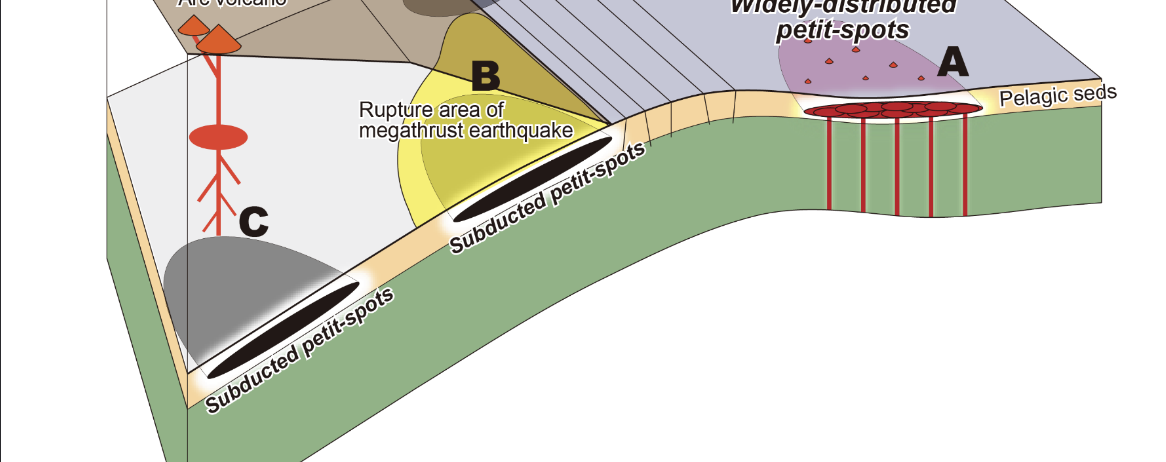
Petit-spots are a recently discovered volcanic system characterised by highly alkalic and CO2-rich basalt generated by a low degree of partial melting of the asthenosphere. These deep mantle melts have been proposed to form and upwell due to the flexure of the oceanic Pacific Plate prior to subduction. IODP3 Expedition 502 aimed to explore the nature of the acoustic basement in the outer rise of the off-Tohoku Japan Trench and test the hypothesis that this acoustic basement is related to petit-spot magmatism. If this hypothesis is correct, petit-spot magmatism at the outer rise may be more widely distributed than previously thought. More extensive petit-spot volcanism could strongly impact our understanding of subduction systems, including rupture nucleation and slip propagation of plate boundary megathrust earthquakes.
IODP3 Expedition 502 successfully conducted logging and coring operations at Site C0027. Logging data were acquired while tripping the bit out of the drillhole from ~86 meters below sea floor (mbsf) to 23.5 mbsf, and cores were recovered from 0–106.5 mbsf. The boundary between the sediment layer and the acoustic basement is observed at ~60 mbsf, marked by a sharp increase in the electrical resistivity logs and a change in lithology. Recovered siliceous muds extend in age back to the late Pliocene. Core recovery in sediment units was nearly 100%, whereas core recovery from the underlying basaltic unit was limited, with an average of ~18%. The basement is composed mainly of fresh glassy and cryptocrystalline basalts. The basalt clearly differs from typical oceanic crust basalts of the Pacific plate in chemical composition, degree of alteration, and physical properties. Although no significant thermal alteration, decomposition, or deformation associated with the petit-spot magmatism was observed in the sediment, changes in sediment colour and pore fluid geochemistry in an interval of ~9 m above the sediment-basement boundary suggest that some fluid-rock reactions occurred between sediments and petit-spot basalt.
The original Expedition 502 Science Team has planned to conduct broad and multidisciplinary analytical approaches using the collected cores and logging/drilling data for petrochemical/geochemical, sedimentological and geochronological analysis, alongside palaeontological studies, palaeomagnetic and rock magnetic analyses, structural, geomechanical and petrophysical analysis, microbiological analysis, logging while drilling analysis, and numerical modelling.
Nouvelles expertises recherchées (en anglais)
With this work ongoing there are now opportunities to include new analytical directions that could complement the original research portfolio and further enhance the scientific value of Expedition 502 materials.
These include, but are not limited to:
- Non-destructive core analysis, including XRF core scanning
- Stratigraphic correlation of sediments with previous DSDP/ODP/IODP sites in the northwestern Pacific
- Geochemical/biological analysis of gas, interstitial water, sediment, and basalt.
- Experimental petrology (melting and quenching) with viscosity measurements
- Hydrological study of sediment and fractured basalt in relation to hydrothermal alteration
Candidature
Les candidatures sont les bienvenues de la part de scientifiques basés en France (la France étant membre d’ECORD, lui même partenaire d’IODP³) qui proposent :
- soit de combler les besoins exprimés à la section précédent, ou toute autre approche permettant d’atteindre les objectifs initiaux de l’expédition sans faire double emploi avec les plans de l’équipe scientifique d’origine ;
- soit d’utiliser les carottes prélevées au cours de l’expédition pour atteindre de nouveaux objectifs et produire de nouvelles connaissances scientifiques non envisagées dans la proposition d’expédition initiale.
Pour plus d’information, veuillez vous référer à l’appel complet : https://iodp3.org/wp-content/uploads/2026/10/Expedition-502-Second-call.pdf
Les candidatures doivent déposées avant 0:59 le 3 novembre 2026 (23:59 BST le 2 novembre) en utilisant le site IODP3 Gateway.