Workshop Magellan3 : iCREATE : Impact Crater Evolution and Terrestrial Environmental Consequences 🗓️2025-12-19
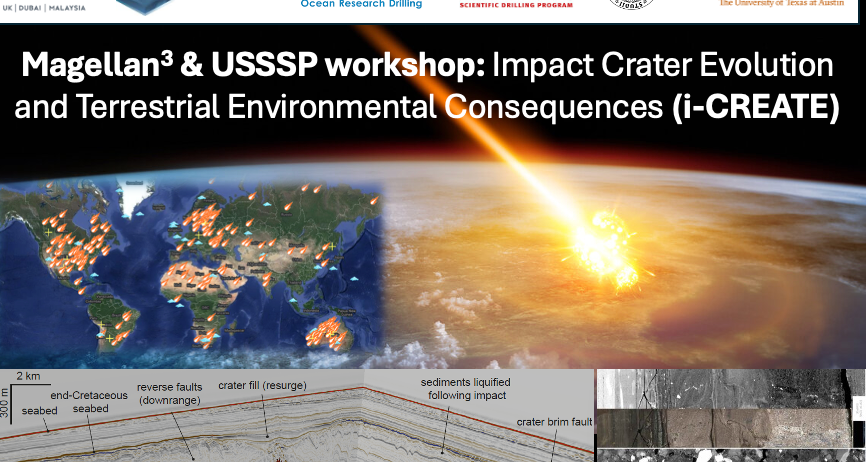
La communauté est invitée à s’inscrire au Workshop ECORD/Magellan3 intitulé « iCREATE : Impact Crater Evolution and Terrestrial Environmental Consequences » qui se tiendra à l’université Herriot-Watt (Edimbourg, Grande-Bretagne) du 29 avril au 1 mai 2026, avec une excursion dans les Highlands du nord-ouest pour visiter les dépôts d’éjectas d’impact de Stac Fada Member. L’objectif est d’élaborer de nouvelles propositions de forage pour étudier les cratères d’impact enterrés, de tester la physique fondamentale de la formation des cratères d’impact et d’étudier les conséquences environnementales de tels événements.
| Inscription par mail (CV+lettre de motivation) à Uisdean Nicholson (u.nicholson@hw.ac.uk) et/ou Sean Gulick (sean@ig.utexas.edu) | 19 décembre 2026 |
| Workshop | 27 – 29 avril 2026 |
| Field trip | 29 avril – 1 mai 2026 |

Contenu scientifique (en anglais)
Scientific motivation
Hypervelocity impacts on planetary surfaces fundamentally change the physical properties of planetary crusts and, after the initial destruction, can generate long-lasting habitable environments. While understanding of impact processes has been strongly guided by the remote observations of crater morphology on the Moon and other worlds, terrestrial craters represent the only opportunity to investigate the subsurface of these structures. Recent Land-to-Sea drilling in the Chicxulub Crater was one of the most successful drilling projects of recent decades, providing groundbreaking insights into the physical mechanisms and environmental consequences of impact.
Craters can be imaged using geophysical surveys, including gravity, magnetic, and seismic datasets. Recent high-quality 3D seismic data have revealed several multiple impact craters in exceptional detail, allowing crater kinematics and deformation mechanisms to be reconstructed or hypothesized. However, recovering physical rock samples is required to confirm impact origin, to provide fundamental insights into how impact shock affects geologic materials, for calibration of impact models and to understand how target properties influence crater structure.
Moreover, chemosynthetic communities having been shown to continue to persist in impact structures millions of years after then event. This has important astrobiological implications, and careful biological sampling of lithologies is required during drilling to assess the extant life and test the role of fluid-rock interactions. Thus, there is a clear need for new scientific drilling and logging of impact structures, confirmed and suspected, to answer critical questions in planetary science, planetary protection and Earth system science, providing invaluable insights into the role of impacts as a geologic and biologic process.
Workshop objectives
The goal is to develop new drilling proposals investigating buried impact craters, to test fundamental physics of impact cratering, and investigate the environmental consequences of such events. This workshop will focus on three main areas of impact research:
- Planetary processes: We will discuss new drilling into the central basin of the Chicxulub impact structure, which would allow recovery of an intact impact melt sheet. This could provide insights into melt differentiation, crustal evolution, and hydrothermal systems. We will also explore other terrestrial impact structures, which would provide analogs for understanding the evolution of Mars, the Moon, and other worlds. These studies will offer fundamental insights into shock processes and determination of stratigraphy and structural relationships across a range of sizes and target characteristics.
- Biological implications and astrobiology: There is a strong connection between the search for extraterrestrial life and drilling impact craters on Earth. For instance, the Chesapeake Bay impact structure and Chicxulub host extant microbial life that are remnant populations of thermophilic organisms still inhabiting impact crater materials 10 million years post-impact. DNA extracted from cores drilled at Chicxulub reveal a remarkably diverse ecosystem within the post-impact hydrothermal system. Future joint agency research should investigate fluid-rock interactions that drive these ecosystems through drilling of terrestrial craters, including Chicxulub. These studies would inspire investigations of potential long-lived subsurface habitats on early Earth and other worlds and potential origin of life scenarios across the Solar System.
- Mid-sized craters: Mid-sized (~3-30 km) complex craters, particularly marine-target craters, are critical to understand as these should represent the most frequent impact events in Earth history. However, they are underrepresented in the terrestrial impact record with only ~30 marine-target craters documented (~15% of terrestrial craters). These structures have the advantage of being fully imaged by geophysical data, which allows for the reconstruction of the kinematics of impact. While numerical models cannot yet capture the rapid physical and chemical changes that occur in target rocks during and immediately after impact (e.g., shock, ejection, vaporization, devolatilization), smaller impact structures present an opportunity to develop and test these models. The Nadir Crater offshore West Africa is a priority target for ocean drilling due to the exceptional quality of 3D seismic covering the impact structure. We will explore other priority candidate/confirmed impact structures that could be prioritized for ocean or onshore drilling, including the Silverpit Crater in the North Sea.
Informations pratiques
- Lieu : Le workshop se tiendra au campus Riccaton, à l’université Herriot-Watt à Édimbourg (Grande-Bretagne)
- Quand : 27 avril au 1 mai 2026. (2.5 jours de workshop et 2.5 jours de visite de terrain)
- Capacité d’accueil : Le workshop est limité à 45 participants environ, il faut donc envoyer sa candidature avant le 19 décembre 2025
- Soutien financier: Les participants provenant d’un laboratoire français (membre ECORD) bénéficieront d’un financement partiel de Magellan3, couvrant les frais d’inscription, la restauration et les dîners de groupe. Un financement dédié peut couvrir les frais de déplacement et de séjour d’un nombre limité de scientifiques en début de carrière, qui sont invités à demander cette aide financière.
- Programme de l’atelier : https://icreate.site.hw.ac.uk/workshop-programme/
| Poser sa candidature avant le 19 décembre : Si vous souhaitez participer à cet événement, veuillez contacter Uisdean Nicholson (u.nicholson@hw.ac.uk) et/ou Sean Gulick (sean@ig.utexas.edu) en joignant un bref CV (2 pages) et une courte lettre de motivation expliquant pourquoi vous souhaitez participer et ce que vous pouvez apporter au workshop |